<?xml version="1.0" encoding="UTF-8"?>
<rss version="2.0"
	xmlns:content="http://purl.org/rss/1.0/modules/content/"
	xmlns:wfw="http://wellformedweb.org/CommentAPI/"
	xmlns:dc="http://purl.org/dc/elements/1.1/"
	xmlns:atom="http://www.w3.org/2005/Atom"
	xmlns:sy="http://purl.org/rss/1.0/modules/syndication/"
	xmlns:slash="http://purl.org/rss/1.0/modules/slash/"
	>

<channel>
	<title>Art Agenda &#187; Reviews</title>
	<atom:link href="http://www.art-agenda.com/category/reviews/feed/" rel="self" type="application/rss+xml" />
	<link>http://www.art-agenda.com</link>
	<description></description>
	<lastBuildDate>Thu, 23 May 2013 04:59:23 +0000</lastBuildDate>
	<language>en</language>
	<sy:updatePeriod>hourly</sy:updatePeriod>
	<sy:updateFrequency>1</sy:updateFrequency>
	<generator>http://wordpress.org/?v=3.0.1</generator>
		<item>
		<title>Gabriel Lester’s “The Secret Life of Cities”</title>
		<link>http://www.art-agenda.com/reviews/gabriel-lester%e2%80%99s-%e2%80%9cthe-secret-life-of-cities%e2%80%9d/</link>
		<comments>http://www.art-agenda.com/reviews/gabriel-lester%e2%80%99s-%e2%80%9cthe-secret-life-of-cities%e2%80%9d/#comments</comments>
		<pubDate>Tue, 21 May 2013 17:05:16 +0000</pubDate>
		<dc:creator>Judith Vrancken</dc:creator>
		<logo><![CDATA[<img width="220" height="146" src="http://www.art-agenda.com/wp-content/uploads/2013/05/1-220x146.jpg" class="attachment-client-logo" alt="Gabriel Lester, The Secret Life of Cities (detail), 2013." title="Gabriel Lester, The Secret Life of Cities (detail), 2013." />]]></logo>
				<category><![CDATA[Reviews]]></category>

		<guid isPermaLink="false">http://www.art-agenda.com/?p=10013481</guid>
		<description><![CDATA[The lust to be a “totalizing eye” immediately sprung to mind when walking into Gabriel Lester’s “The Secret Life of Cities.” It’s one of the key notions expressed in Michel de Certeau&#8217;s chapter &#8220;Walking in the City&#8221; that &#8220;the fiction of knowledge is related to [the] lust to be a]]></description>
			<content:encoded><![CDATA[<p>The lust to be a “totalizing eye” immediately sprung to mind when walking into Gabriel Lester’s “The Secret Life of Cities.” It’s one of the key notions expressed in Michel de Certeau&#8217;s chapter &#8220;Walking in the City&#8221; that &#8220;the fiction of knowledge is related to [the] lust to be a viewpoint and nothing more.&#8221;(1) But as de Certeau’s title suggests, he prefers walking in the city whereas Lester apparently enjoys the hidden refuge of its shrubbery. Taken in Shanghai, New York, Sharjah, and Dubai, Lester&#8217;s images are all are shot in the midst of city park bushes. Despite the great distinctions between these metropolises, Lester’s photographs leave the cities to an uncertain anonymity, showing no signs of exceptional cultural identity. In the photographs—seven in total and named in a variation on the show&#8217;s title (for example, <em>The Cities of Secret Lives</em>)—the cityscapes rise in high rectangular and jagged lines above the occasionally exotic looking thicket. City soundtracks from the video projection on view in another part of the space penetrate the gallery&#8217;s front room so that it cleverly creates a sense of three-dimensionality when taking in the photographs.</p>
<p>The eponymous two-channel video installation consists of two screens opposing each other. A small bench is placed in the middle for visitors to sit, forcing one to twist and turn as interest in one cityscape is lost and found in another, enabling the impossible: being in two cities at the same time. The boundary lines created by the off-focus layering of greenery whilst zooming in on random city life could potentially determine the limits of the work when taking the classical notion of the inside/outside opposition to mind. However here, it creates a double bind both in the photographs as well as the video piece: the only possibility of contemplating Lester&#8217;s constructions are from inside the bushes; that is, very much outside of bustling city life. In this respect, <em>The Secret Life of Cities</em> (2013) can be interpreted as a metaphysical work of desire transcending the self-containment of being and place. It’s his own personal rhetoric, an exploration of areas that have escaped any planned or regulated city scheme. Within a city&#8217;s “social choreography” where movement is regulated by streets and buildings, and relaxation and stillness are delegated to city parks, Lester designates a new meaning and purpose to those areas. Furthermore, the framed shots instantaneously demystify life from a distance; they offer small windows to other worlds where life supposedly takes place. As is shown in previous works by the artist, this <em>mise-en-abyme</em> layering of screens is a recurring theme for Lester, albeit one that he consistently improves upon and varies. And at Galerie Fons Welters, <em>The Secret Life of Cities</em>, too, confirms the viewer&#8217;s role as an audience of life&#8217;s theater where all performances are social ones.</p>
<p>This theatrical notion is further enhanced by the artist&#8217;s use of accompanying city sounds, which he unmistakably composed as an experimental musical score. Thus, the cities are in constant dialogue with the abstract sound fields that Lester has taken from the surroundings. At times it&#8217;s exciting and intriguing, with surprising changes between blocks of sharp percussive violence (think concrete drills) and lyrical passages of birds singing and children playing. At other times the loudest noises are overwhelming, if not deafening—all to be exchanged abruptly by the soft rustling of leaves and layered soundscapes of engines meditatively growling in the background. These sounds are about everything we are surrounded by but never seem to hear. And through these rhythmic patterns, Lester ostensibly attempts to give a new sense of direction to the untamable and unpredictability of city life. The result is an experience that exists nowhere else except for the here and now.</p>
<p>&nbsp;</p>
<p>(1) Michel de Certeau, <em>The Practice of Everyday Life</em>, trans. Steven Rendall (Berkeley: University of California Press, 1984), 91–110.</p>
]]></content:encoded>
			<wfw:commentRss>http://www.art-agenda.com/reviews/gabriel-lester%e2%80%99s-%e2%80%9cthe-secret-life-of-cities%e2%80%9d/feed/</wfw:commentRss>
		<slash:comments>0</slash:comments>
		</item>
		<item>
		<title>“U.F.O.-NAUT JK (Július Koller) orchestrated by Rirkrit Tiravanija”</title>
		<link>http://www.art-agenda.com/reviews/%e2%80%9cu-f-o-naut-jk-julius-koller-orchestrated-by-rirkrit-tiravanija%e2%80%9d/</link>
		<comments>http://www.art-agenda.com/reviews/%e2%80%9cu-f-o-naut-jk-julius-koller-orchestrated-by-rirkrit-tiravanija%e2%80%9d/#comments</comments>
		<pubDate>Fri, 17 May 2013 16:43:57 +0000</pubDate>
		<dc:creator>Simon Rees</dc:creator>
		<logo><![CDATA[<img width="220" height="220" src="http://www.art-agenda.com/wp-content/uploads/2013/05/01_JANDA_Tiravanija_Koller-220x220.jpg" class="attachment-client-logo" alt="Július Koller, Otáznik (Anti-Happening), 1969." title="Július Koller, Otáznik (Anti-Happening), 1969." />]]></logo>
				<category><![CDATA[Reviews]]></category>

		<guid isPermaLink="false">http://www.art-agenda.com/?p=10013416</guid>
		<description><![CDATA[Anyone who grew up in the 1970s and watched the Children’s Television Network/PBS educational series Sesame Street was subliminally prepared for the gamut of conceptualism in (contemporary) art. No character prepared one better than the “Mad Painter,” who popped up in the unlikeliest of places in his Chaplinesque bowler hat]]></description>
			<content:encoded><![CDATA[<p>Anyone who grew up in the 1970s and watched the Children’s Television Network/PBS educational series <em>Sesame Street </em>was subliminally prepared for the gamut of conceptualism in (contemporary) art. No character prepared one better than the “Mad Painter,” who popped up in the unlikeliest of places in his Chaplinesque bowler hat and signature striped shirt to paint the “number of the day” on an unsuspecting surface or person: bald or balding pates were regularly and hilariously victimized. They always realized their fate all-too-late and then chased the Mad Painter out of the frame, oftentimes with the reel sped up to look like the Keystone Cops, or, again Chaplin, to the accompaniment of a vaudevillian or ragtime/honky-tonk piano. While Július Koller (1939–2007) was making his “U.F.O.-NAUT” works long before the Mad Painter ever went on air, whether Rirkrit Tiravanija’s channeling of Koller performs a double-entendre of channeling the Mad Painter is the question. Tiravanija, born in 1961, is certainly of an age and spent time growing up in Canada where <em>Sesame Street</em> was a television staple in the 1970s. This exhibition is essentially a re-presentation and re-framing of Koller’s “U.F.O-NAUT”<em> </em>works by Tiravanija—to claim a sympathetic conceptual predecessor.</p>
<p>The Mad Painter comes to mind because in the “U.F.O.-NAUT” series Koller paints question marks on unsuspecting surfaces not usually associated with art, and particularly, his penchant was for table tennis paddles and tennis racquets. (Though Koller would hardly have made the connection in 1969 when he commenced the series, table tennis paddles look similar to the paddles used for bidding at auctions, and one could well imagine him performing agitprop at Christie’s or Sotheby’s). In one especially Mad Painteresque black-and-white photographic performance documentation <em>Otáznik </em>(<em>Anti-Happening</em>, 1969) Koller paints a question mark onto the surface of a clay court, using a chalk-line marking roller. In the photographs <em>Question Mark 1–4</em>, <em>Anti-Happening</em> (also 1969) he inscribes the mark on the court using his hands and feet. The photographic portrait that follows in 1972—<em>Univerzálna Fyzkultúrna Orientácia (U.F.O.)—</em>depicts Koller in full tennis whites, including a handsome cable-knit sweater, with a UFO club emblazoned on his chest and question mark on the racquet strings.</p>
<p>Why tennis, one might ask? I would hazard to reflect on the fact that the most famous thing about communist Czechoslovakia at that time was the tennis player Jan Kodeš who won successive French Opens in 1970 and 1971 and then Wimbledon in 1973, and was twice runner-up at the US Open in 1971 and 1973. As an artist trying to bridge the divide between the Warsaw Pact countries and the rest of the world—where a more public conceptual practice was unfolding—sports seems a reasonable and universal signifier. Conceptualism was always contrary and as universal as sport might be it is considered antithetical to art. For this reason, it seems an all-too-fitting signifier-cum-vehicle. (Futhermore, at the time that Kodeš was at his peak, one of his greatest rivals was the Romanian Ilie Năstase, so there was a real Cold War conversation going on here.) Tiravanija’s own principal contribution to the exhibition is a set of table tennis tables, each of which is emblazoned with the text “MORGEN IST DIE FRAGE” [Tomorrow is the question], which lends the works their “untitled” title <em>Untitled (MORGEN IST DIE FRAGE)</em> (all works, 2012). Considering this contextual and historical setting, coupled with the fact that Tiravanija is by heritage Asian, the tables evoke something of the same era of 1970s Cold War relations between the United States and the People’s Republic of China known under the moniker “Ping-pong diplomacy.” The term described the sending of a team of US table tennis players to China in 1971 to play in a tournament that was promoted under the banner “Friendship First, Competition Second”<em> </em>that acted as a forerunner to President Richard Nixon’s visit to Mao’s PRC in 1972.</p>
<p>Of course the nature of much of Tiravanija’s practice is based on terms of “hospitality,” whether that described by Jacques Derrida or Donna Haraway, as embodied by the collective farm/residency that Tiravanija is involved with in northern Thailand, or, in the case of his cooking, Charmaine Solomon. There are also his collaborations with the likes of Superflex and the unitednationsplaza project in Berlin and its international offshoots. Indeed, he could happily make a future set of tables including the text “Friendship First, Competition Second.” The spirit is certainly reflected in the way he embraces Koller within the framework of the exhibition at Galerie Martin Janda; and in the way visitors at the opening played table tennis together. The gallery also plans a friendly tournament on the closing weekend.</p>
<p>Moreover, a great deal of friendliness emanates from the 2013 performance <em>Untitled (Remember JK, Universal Futurological Question Mark U.F.O.) </em>that assembled a diverse set of people to stand in the form of a question mark on the square in front of Vienna’s St. Stephen’s Cathedral on a drab early-March Saturday morning, to be photographed aerially. Coincidentally, the event took place at the same time the Conclave of Cardinals voted on the new Pope, lending some unintended politics (and certainly poetic justice) to the action. Light on numbers, the assortment of gallery staff, family, and friends who had gathered were joined by a group of Italian tourists who, in the spirit of friendliness, ensured critical mass—and a proper testament to Koller. I am sure that if U.F.O.s happened to land, despite the weather, the aliens would have been impressed.</p>
]]></content:encoded>
			<wfw:commentRss>http://www.art-agenda.com/reviews/%e2%80%9cu-f-o-naut-jk-julius-koller-orchestrated-by-rirkrit-tiravanija%e2%80%9d/feed/</wfw:commentRss>
		<slash:comments>0</slash:comments>
		</item>
		<item>
		<title>Henri Chopin’s “La Crevette Amoureuse”</title>
		<link>http://www.art-agenda.com/reviews/henri-chopin%e2%80%99s-%e2%80%9cla-crevette-amoureuse%e2%80%9d/</link>
		<comments>http://www.art-agenda.com/reviews/henri-chopin%e2%80%99s-%e2%80%9cla-crevette-amoureuse%e2%80%9d/#comments</comments>
		<pubDate>Wed, 15 May 2013 17:52:44 +0000</pubDate>
		<dc:creator>Vincenzo Latronico</dc:creator>
		<logo><![CDATA[<img width="220" height="146" src="http://www.art-agenda.com/wp-content/uploads/2013/05/chopin_1-220x146.jpg" class="attachment-client-logo" alt="View of Henri Chopin’s “La Crevette Amoureuse,” Supportico Lopez, Berlin, 2013." title="View of Henri Chopin’s “La Crevette Amoureuse,” Supportico Lopez, Berlin, 2013." />]]></logo>
				<category><![CDATA[Reviews]]></category>

		<guid isPermaLink="false">http://www.art-agenda.com/?p=10013404</guid>
		<description><![CDATA[The traditional form of the novel, as we know it since the nineteenth century, seems oddly impervious to change. In comparison to the extraordinary evolutions undergone by art, very little has changed between today’s mainstream fiction and its Balzac, Austen, and James equivalents. Most of the novel’s purported evolutions have]]></description>
			<content:encoded><![CDATA[<p>The traditional form of the novel, as we know it since the nineteenth century, seems oddly impervious to change. In comparison to the extraordinary evolutions undergone by art, very little has changed between today’s mainstream fiction and its Balzac, Austen, and James equivalents. Most of the novel’s purported evolutions have either proven to be barren (as Julio Cortázar’s 1963 <em>Rayuela</em>, a masterpiece which left in its wake a string of choose-your-own-ending fictions) or resorted to the more or less forceful insertions from other disciplines: pictures, traditionally, or sound and video in their most recent tablet incarnations. A text-based fiction, it would seem, has few places to go except where it already is.</p>
<p>This state of affairs is both questioned and affirmed by the work of the late Henri Chopin, whose, well, novel, <em>La crevette amoureuse</em> [The loving shrimp], (1967/1975)—is on show in Berlin at Supportico Lopez. Throughout most of the twentieth century Chopin has been a prominent experimental poet and performer (born in Paris in 1922, he remained productive until 2008, the year he died); one of the first and most prolific practitioners of concrete and sound poetry, Chopin was also a publisher of journals such as <em>Cinquième Saison</em> (1959–1963) and <em>Revue OU </em>(1964–1974). The trilogy collectively titled <em>Le dernier roman du monde</em> [The last novel in the world] was begun in 1961 and never fully published: its first, eponymous installment appeared in a limited edition in French in 1971, while its other two parts have only been circulated privately by collector Peppe Morra. Of that novel, <em>La crevette amoureuse</em> is the third and final section. The exhibition showed 145 of its 146 typewritten pages, displayed in tilted vitrines that tried as much as possible to avoid all fetishizing effect and actually facilitate reading while standing.</p>
<p>The book is a philosophical parable, consisting of several dialogues between ERnest and MARiette, usually taking place before or after sex. He is characterized as a “head of state” or “head of the world,” and peppers his pillow talk with political concerns, the arbitrary laws and decrees of his own domain; his solipsism and arrogance are sometimes spurred on, sometimes discouraged by MARiette. As the book progresses, ERnest&#8217;s philosophical boutades appear to be a satire of the intellectualized epistemology of the Descartes-Berkeley-Hume-Kant-Fichte lineage. The text is in fact explicitly dedicated to Kant, whose self-centered brand of skepticism finds an extreme echo in ERnest’s absolutism as a ruler. Increasingly frustrated by the exercise of a power as absolute as it is vacuous (for his theories prevent him from acknowledging the existence of other subjects—both in the philosophical and in the political sense), ERnest ultimately resolves to forsake his name and, thereby, his subjectivity.</p>
<p>This summary, however, does little justice to <em>La crevette amoureuse</em>, which is visual as much as it is textual. Interspersed in its typewritten pages are both abstract and figurative compositions of symbols, reminiscent of Futurist poetry and of typographic art. Even though sometimes illustrative (the book includes portraits of its main characters, as well as geometric patterns), these compositions hardly qualify as illustrations as such, since in a way they are the text itself—they are literally made of the same stuff. The two “forms” flow into each other with no clear way of separating narration and image; at times Chopin explicitly challenges the meaningfulness of such distinctions, as when he presents a triangular sequence of punctuation marks as the text of one of ERnest’s last decrees.</p>
<p>This is in line with Chopin’s writing style, reminiscent of the French tradition of circling around or brushing against the absurd (from Jarry to Tzara and Ionesco). Dialogues in <em>La crevette amoureuse</em> often start out as realistic, then veer towards the surreal (through exponential chains of puns and word-play), only to ultimately graze across the downright nonsensical. The step from this to the altogether visual, non-linguistic use of symbols appears to be quite small: sentences gradually lose meaning, then words, then letters. (“All this beauty means nothing at all,” announces one such page.) Someone not versed in the history of philosophy might not be able to distinguish between the Dadaist impromptus and quotations from Kant; someone without more than a passing knowledge of French would likely be unable to discriminate words from puns. Quite similarly, a being unfamiliar with the way human languages are written (such as an alien life form, or, for that matter, a cat) would see no distinction between what we consider “text” and “illustration.”</p>
<p>Chopin’s <em>dactylopoèmes </em>thus appear to be more than witty abstract compositions, or mere (if beautifully crafted) instances of typographic art: in this novel they are legitimate parts of a text. They are not appropriations or “misuses” of linguistic means to serve a pictorial end: they are extreme instances of their proper use—evolutions, if you like.</p>
<p>There might be something to be said about such a significant and innovative work of literature finding its place in a gallery exhibition instead of a literary context (Chopin’s work has also recently been shown, among others, at the MoMA in New York). Such a place was undoubtedly sanctioned and sought out by the writer himself: each sheet of the manuscript is visibly, and quite uncannily, signed signaling something closer to a page’s own independence rather than its interconnectedness with other pages in a novel. This, on the one hand, bespeaks the fact that, “Almost nowhere else does the pure textuality of the text show itself so clearly as in art” (to paraphrase a point Boris Groys originally made about art criticism); but also that, after the disappearance of what had once been their elective publics, radical innovators from all disciplines are increasingly seeking both shelter and an audience within the art system, seen as a sort of refugee camp for experimental practices. Yes, there might be something to be said about this—and it wouldn’t necessarily be optimistic. And yet for the last novel of the world, a refugee camp might be a suitable home, after all.</p>
]]></content:encoded>
			<wfw:commentRss>http://www.art-agenda.com/reviews/henri-chopin%e2%80%99s-%e2%80%9cla-crevette-amoureuse%e2%80%9d/feed/</wfw:commentRss>
		<slash:comments>0</slash:comments>
		</item>
		<item>
		<title>New York Gallery Round up</title>
		<link>http://www.art-agenda.com/reviews/new-york-gallery-round-up/</link>
		<comments>http://www.art-agenda.com/reviews/new-york-gallery-round-up/#comments</comments>
		<pubDate>Mon, 13 May 2013 18:40:05 +0000</pubDate>
		<dc:creator>Tyler Coburn</dc:creator>
		<logo><![CDATA[<img width="220" height="165" src="http://www.art-agenda.com/wp-content/uploads/2013/05/1_LRDE-Exhibition-view02-small-220x165.jpg" class="attachment-client-logo" alt="View of Lili Reynaud-Dewar’s “I AM INTACT AND I DON&#039;T CARE,” CLEARING, New York, 2013." title="View of Lili Reynaud-Dewar’s “I AM INTACT AND I DON&#039;T CARE,” CLEARING, New York, 2013." />]]></logo>
				<category><![CDATA[Reviews]]></category>

		<guid isPermaLink="false">http://www.art-agenda.com/?p=10013365</guid>
		<description><![CDATA[For the entirety of the year, Lili Reynaud-Dewar will only make and exhibit bedrooms. Her current exhibition at CLEARING, New York, contains the requisite furniture, though the French artist seems less inclined to follow in the theatricality of Claes Oldenburg’s Bedroom Ensemble (1964) than to meditate on the conditions necessitating]]></description>
			<content:encoded><![CDATA[<p><span style="font-size: 13px; line-height: 19px;">For the entirety of the year, Lili Reynaud-Dewar will only make and exhibit bedrooms. Her current exhibition at CLEARING, New York, contains the requisite furniture, though the French artist seems less inclined to follow in the theatricality of Claes Oldenburg’s </span><em>Bedroom Ensemble</em><span style="font-size: 13px; line-height: 19px;"> (1964) than to meditate on the conditions necessitating that an artist make a bedroom of an exhibition. As Frieze New York adds yet another stop on the art fair circuit, Reynaud-Dewar’s exhibition reminds us of how artists must also negotiate the migratory and the local, the studio and the home. These subjects are also brought to bear on contemporaneous outings by Edgardo Aragón, Alex Hubbard, and Paul McCarthy. That we are some years from the apex of theorization on the globalized artist, in other words, does not mean that our cultural practitioners are any less implicated in cosmopolitanism’s waxing demands and effects.</span></p>
<p>Reynaud-Dewar’s bedrooms reflect both the general condition of a migratory artist and the specific challenges faced by women, who are particularly impaired, she claims, by the imperative to have and keep a home. If Virginia Woolf forcefully argued for the cultural and literal room for women to work, then Reynaud-Dewar suffers from the inverse dilemma of having no shortage of exhibition rooms and yet none that could be properly called her own. The artist’s encounters with domesticity only last the length of an exhibition or residency, and perhaps their very ephemerality affords her incisive view on the spatial bounds of artistic life. “I AM INTACT AND I DON’T CARE” at CLEARING, for example, includes a fountain spewing black ink into a queen-size bed; its risible premise is more than corroborated by the willfully schlocky manufacture, which cites inspiration in the world of things, of bodies, and of desire incarnate. Splattering its white sheets with creative surplus, the sculpture nods to the artist’s copious literary heroes and, more directly, to the touchstones in her ongoing work with race. On a nearby flat screen, a blackened Reynaud-Dewar mimes Josephine Baker’s dances in the Vienna residency studio, exhibition, and collection halls of the Belvedere. She has previously expressed admiration for Sun Ra’s rerouting of origins, though throwing one’s voice to Saturn carries a far different register than dancing in the style of a racialized other.</p>
<p>While Reynaud-Dewar’s sincere investment in racial history bridges obvious divides, Edgardo Aragón’s work is borne of an intimacy with its subjects and locales. The self-described “offspring of economic devaluations and state bankruptcy and pillage,” Aragón (born in 1985) traces the unfolding effects of Mexican neoliberalism within families, across generations, and for working communities, deliberately shifting focus from Mexico City to regions like his home state of Oaxaca. <em>Tesoro</em> [Treasure]<em> </em>(2013), the eponymous centerpiece of his first New York gallery exhibition at Laurel Gitlen, takes form as two rows of tables displaying photographs of the jewels and keepsakes of ten Mexican families. Modest testaments to accumulation, these collections are also marked by signs of financial straits and dismal economic periods, when jewelry carried more value than currency: a chain necklace in one photograph, for example, has been scavenged of all but two links. In the back gallery, Aragón’s video <em>La Encomienda</em> (2013) captures an informal chorus of young men singing into the mouth of an old gemstone mining cave in Oaxaca. Comprising mining protest slogans from throughout Latin America, the song gauges the histories and reverberations of this contentious site. A variation, sung by a lone performer, will sound the shallow depth of the Tiffany flagship store’s façade in the coming weeks.</p>
<p>From <em>A Room of One’s Own</em> to a bar of one’s own: such is the liquid courage on offer at Alex Hubbard’s second solo exhibition at Maccarone, “Magical Ramón and The Five Bar Blues,” spread over two spaces. Five retrofit shipping crates contain all of the necessary fixings, from a built-in keg and liquor supply to the swinging saloon doors, bar stool, and foot rests that can help a good drunk lean into it. In certain circumstances, the cramped quarters can only do so much to accommodate their props, and Hubbard is compelled to halve a beer neon, for example, rather than forgo a necessary part of the mise en scène. As the exhibition title makes clear, such charming effects thinly belie the melancholia of these units, eliciting consideration of why present circumstances might compel such alienating extremes—and recalling past depressives like Montgomery Clift, who famously built a one-man bar into his New York townhouse. Little else in the show rises to this synthesis of pathos and form: Hubbard’s urethane casts of trash agglomerations have grown sedate since their aerobic performance at Eva Presenhuber’s Zurich gallery a few months ago, though continue to offer impressive homologies to his process-intensive videos. The press release describes a new series of works as “glib portrayals of current painting,” in which Hubbard sets bare and resin-coated linen in gilded antique frames, mounted with cast urethane abalone-shell sconces that illuminate the surfaces. Perhaps success can be measured in how closely the works resemble their targets, which is to say that the satire of disingenuousness here is barely differentiable from disingenuousness itself.</p>
<p>This critique, of course, could also be leveled at Paul McCarthy’s eighty-foot-tall, inflatable <em>Balloon Dog </em>(2013), presently taunting Jeff Koons outside of the Frieze New York tent. The sculpture is by far the dullest jewel in the Los Angeles artist’s crown, which over the coming months will be set with multiple exhibitions at Hauser &amp; Wirth and a massive installation at the Park Avenue Armory. At press time, the artist had already plopped down the massive bronze <em>Sisters</em> (2013) in the Hudson River Park, scandalizing and titillating joggers and cyclists with the grisly aftermath of a <em>Snow White</em> sculpture session gone awry, in which the heroine and her wooded friends were made to suffer like the saints. The violence grows muter at the 18th Street gallery, owing in part to the stately black walnut, which indexes the transmogrification of Disney tchotchkes, first into digital hybrids and then analog forms. From <em>Heidi</em> to <em>Pinocchio</em>, McCarthy has long symptomized the mainstays of Americana, and in the dimensionless field of virtual design, he finds a potent new analogy for the ambient and unceasing projections of our cultural phantasms.</p>
<p>We will conclude with McCarthy poised to Cromwell the New York art world, Aragón following the chain links to a Fifth Avenue flagship, and Reynaud-Dewar en route to her next bedroom. Even Hubbard seems to have harnessed the global flows; his bars may offer the coffin comforts of boozy dead ends, but these dead ends are ready to ship.</p>
]]></content:encoded>
			<wfw:commentRss>http://www.art-agenda.com/reviews/new-york-gallery-round-up/feed/</wfw:commentRss>
		<slash:comments>0</slash:comments>
		</item>
		<item>
		<title>Frieze New York</title>
		<link>http://www.art-agenda.com/reviews/frieze-new-york-3/</link>
		<comments>http://www.art-agenda.com/reviews/frieze-new-york-3/#comments</comments>
		<pubDate>Fri, 10 May 2013 23:17:53 +0000</pubDate>
		<dc:creator>Karen Archey</dc:creator>
		<logo><![CDATA[<img width="220" height="146" src="http://www.art-agenda.com/wp-content/uploads/2013/05/1_frieze-lead-220x146.jpg" class="attachment-client-logo" alt="View of Frieze New York Sculpture Park with Paul McCarthy, Balloon Dog, 2013." title="View of Frieze New York Sculpture Park with Paul McCarthy, Balloon Dog, 2013." />]]></logo>
				<category><![CDATA[Reviews]]></category>

		<guid isPermaLink="false">http://www.art-agenda.com/?p=10013314</guid>
		<description><![CDATA[“Contemporary art: one, us: zero,” quipped a friend as we mistakenly toured what appeared to be the off-limits back room of Marian Goodman’s booth at Frieze New York. We were looking for Tino Sehgal’s performance Ann Lee. Aware of the nature of Sehgal’s work probing social boundaries through real life]]></description>
			<content:encoded><![CDATA[<p><span style="font-size: 13px; line-height: 19px;">“Contemporary art: one, us: zero,” quipped a friend as we mistakenly toured what appeared to be the off-limits back room of Marian Goodman’s booth at Frieze New York. We were looking for Tino Sehgal’s performance </span><em>Ann Lee</em><span style="font-size: 13px; line-height: 19px;">. Aware of the nature of Sehgal’s work probing social boundaries through real life situations, my partner and I weren’t </span><em>entirely</em><span style="font-size: 13px; line-height: 19px;"> convinced our foray into Goodman’s secret room wasn’t part of the performance itself. Our mishap was worthwhile though: it brought us to Ann Lee, an adolescent girl performing a monologue as a fictional Manga character originally developed by Pierre Huyghe and Philippe Parreno in 1999. The duo had purchased the rights to the character from a Japanese animation company, and subsequently invited other artists, such as Dominique Gonzalez-Foerster, Rirkrit Tiravanija, and Liam Gillick, to include her in their work. Originally a vacant character, she is figuratively filled by the artist’s intention. Sehgal’s version of Ann Lee comprises a rotating cast of confident, “robotic” 11-year-old girls, replete with mechanical limb movements, who directly engage audience members with questions like “Would you rather be too busy or not busy enough?” (Unsurprisingly, most audience members preferred to be too busy.) The piece examines a collective desire to be filled or occupied—with distraction, personal fulfillment, or what have you—and in turn, a fear of stagnation and vacancy. That “Ann Lee” focuses on the art fair goer seems an exceedingly apropos subject for the opening day of Frieze, which was mottled with well-shorn, busybody alpha patrons.</span></p>
<p>Though its performative nature and challenging salability is undoubtedly anomalous, Sehgal’s performance epitomizes the high quality of work at Frieze New York’s sophomore edition. The fair’s serpentine SO – IL-designed tent boasts twenty more booths than last year’s effort, reaching to 180 galleries in total. And while the titanic amount of galleries proves it impossible to adequately see the entire fair in one day (I was there a total of six hours and can only hope I caught a glimpse, at least, of everything), the overall tone of Frieze New York’s opening day was posh, bright, contemporary, and poised in addition to the usual bourgeois art fair goings-on, and the presence of decidedly cool, emerging artists penetrated the fair.</p>
<p>Most satisfying were booths resuscitating vintage chromogenic prints from decades past. Elizabeth Dee showed a photographic pairing by the lesser-known British photographer Mac Adams. The first photograph depicts a man seemingly wiring a bouquet of daffodils to spy on an unsuspecting woman, the second showing the subject at home amidst the arrangement, perhaps being unwittingly recorded. Titled <em>Conversation [Diptych], </em>the 1975 piece compresses crime narrative into highly staged mise en scène, a rare potential historical analog to the increasingly celebrated, idiosyncratic young conceptual artist Alejandro Cesarco. (With Murray Guy, Cesarco’s installation-cum-detective story <em>The Streets Were Dark with Something More Than Night or the Closer I Get to the End the More I Rewrite the Beginning</em> won the Baloise Art Prize at Art Basel in 2011.) For Frieze New York, Murray Guy presented Zoe Leonard’s vintage chromogenic prints, most of which were taken during her forays to remote Alaska in the mid-90s. The striking images—ranging from depictions of a dismembered bear and moose to a dead beaver laid prone in his watery grave—build upon feminist investigations into the gaze endemic to the 1980s, positioning the human being as predator and consumer. At Reena Spaulings, Ken Okiishi’s breathtakingly honest (but unsent) 1997 postcards addressed to art world luminaries such as Larry Clark or Jack Pierson track his coming-of-age lust for a straight friend—a gay rendering of the universal experience of potent desire, rejection, and consequent alienation.</p>
<p>The relative lack of work made before the 1970s was assuaged by a few unique, hard-hitting presentations from artists with decades-old careers. Gagosian showcased a work from Robert Rauschenberg’s lesser-known series of <em>Gluts</em>, metal assemblage sculptures made primarily in the late-eighties while the artist was visiting an economically depressed Texas. Paris’s Galerie Chantal Crousel showed an unusual vitrine-bound but characteristically explosive Thomas Hirschhorn, while B. Wurtz’s grocery-themed paper collages puzzled and dazzled at Richard Telles Fine Art.</p>
<p>The fair ushered in an exciting bevy of young London imports relatively unexposed in New York. London’s The approach brought Magali Reus’s strangely poetic custom-made stadium seats propped up by a crutch leg, meditating on notions of public support, as well as Alice Channer’s hybrid-state, droopy resin clothing. Carlos/Ishikawa, also of London, presented a solo showing by Steve Bishop one could likely smell before they see. In addition to a cutting of the gallery’s wall repositioned as a temporary structure delineating the booth, Bishop’s Listerine tray hilariously and noxiously permeates the fair—a new take on “cutting through fair bullshit.” Shoreditch’s Limoncello presented an Ikea kitchen-inspired installation replete with ceramics by Jesse Wine, who is perhaps on top of the never-ending surge in contemporary art pottery. David Raymond Conroy’s work at Seventeen wraps paravents in fabric (more commonly associated with African clothing), and juxtaposes them with photographic collages meditating on the functionality and history of photography.</p>
<p>London’s contemporaries across the pond presented equally successful, materially inventive work by young Americans. Gavin Kenyon’s bulbous yet phallic, fuzzy plaster works impart a dark take on relatively traditional sculpture at Lower East Side’s Ramiken Crucible. Fellow LES gallery 47 Canal shows the similarly inventive Stuart Uoo, who is the subject of a current two-person exhibition with Jana Euler at the Whitney Museum of American Art (Euler’s winsome paintings can be seen in the fair at Brussels gallery dépendance’s booth). Uoo’s work at 47 Canal comprises a set of busts representing, in a degraded, post-human fashion, each of the famed four females of “Sex and the City.” The mannequins, burnt, are fashioned with floppy hats, bandanas, and tutus, and tout wires for veins. Nearby hang a selection of exceedingly tacky yet expensive designer fabrics that help position Uoo’s busts as belonging to a private, post-identity fantasy world in which a gay (or straight, for that matter) man is just as likely to identify with Carrie Bradshaw as any undergrad co-ed.</p>
<p>If there’s anything surprising about Frieze New York’s second year, it’s perhaps the seamlessness of its presentation. Is the fair’s continued success too good to be true, especially given the long history of the Armory’s struggle for relevance? While the fair’s private usage of public, tax-supported New York property and the company’s refusal to hire unionized workers has precipitated heated New York City Council meetings (1), these issues have yet to turn many heads in the art world. No one wants to rain on the Frieze parade, presumably because New York has yearned so long for a hip, commercially viable fair. It could be argued that Frieze (and not entirely unlike this publication) is built on a highly commercial yet alternative, self-sustaining funding system. This well-oiled machine accrues cultural capital from Frieze’s exceptionally edited magazine, which in turn creates an attractive brand, fueling the pay-to-play desire to show in the fair. While this structure isn’t especially pernicious, it explicitly represents a new model of power: just to be rich or cool isn’t enough to claim your place at the front of the rat race. Today, you have to be both.</p>
<p>&nbsp;</p>
<p><span style="font-size: 13px; line-height: 19px;"> </span></p>
<p>1) http://teamsternation.blogspot.com/2013/05/new-york-city-council-hearing-slams.html </p>
]]></content:encoded>
			<wfw:commentRss>http://www.art-agenda.com/reviews/frieze-new-york-3/feed/</wfw:commentRss>
		<slash:comments>0</slash:comments>
		</item>
		<item>
		<title>Ryan Gander’s “Once upon a Bicycle, not so long ago”</title>
		<link>http://www.art-agenda.com/reviews/ryan-gander%e2%80%99s-%e2%80%9conce-upon-a-bicycle-not-so-long-ago%e2%80%9d/</link>
		<comments>http://www.art-agenda.com/reviews/ryan-gander%e2%80%99s-%e2%80%9conce-upon-a-bicycle-not-so-long-ago%e2%80%9d/#comments</comments>
		<pubDate>Tue, 07 May 2013 16:57:03 +0000</pubDate>
		<dc:creator>Arnisa Zeqo</dc:creator>
		<logo><![CDATA[<img width="220" height="146" src="http://www.art-agenda.com/wp-content/uploads/2013/05/1_installation-view-big-220x146.jpg" class="attachment-client-logo" alt="View of Ryan Gander’s “Once upon a Bicycle, not so long ago,” Annet Gelink Gallery, Amsterdam, 2013." title="View of Ryan Gander’s “Once upon a Bicycle, not so long ago,” Annet Gelink Gallery, Amsterdam, 2013." />]]></logo>
				<category><![CDATA[Reviews]]></category>

		<guid isPermaLink="false">http://www.art-agenda.com/?p=10013160</guid>
		<description><![CDATA[Black-and-white photo wallpaper depicting a gargantuan hand holding an iPhone with two text message bubbles visually dominates Ryan Gander’s show at Annet Gelink in Amsterdam. With the imperative title Be Prepared (2013) the stage is set for potential. I learn that the text displayed on the phone describes a]]></description>
			<content:encoded><![CDATA[<p><em> </em></p>
<p>Black-and-white photo wallpaper depicting a gargantuan hand holding an iPhone with two text message bubbles visually dominates Ryan Gander’s show at Annet Gelink in Amsterdam. With the imperative title <em>Be Prepared </em>(2013) the stage is set for potential. I learn that the text displayed on the phone describes a probable artwork the artist thought of making while at a party. The first message reads like an absurdist title to an overtly simple sculpture, which looks like a person wearing a bed sheet over their head: “sheet thrown over her thinking about a young man writing a lecture about recent reinvention of car headlights and the cultural implications…” While the second message builds, like an exquisite corpse, on the visual details <em>not</em> of the artwork itself, but of the setting and (“importantly,” the artist tells us) of the <em>viewer</em>: “Black range rover aesthetic, blacked out mirrored window, black shiny spray paint, silver textual logo, A–Symmetrical, use unfathomable, someone looking at it is the most important aspect, young woman reclining nude with sheet thrown over her thinking about a young man writing a lecture about recent reinvention of car headlights and the cultural implications…” Forget about her “reclining nude,” forget about her thoughts. She’s covered, after all, with a sheet!</p>
<p>When describing the art of Andy Warhol, art historian Benjamin Buchloh wrote that Warhol embodied the paradox of modernist art. But what is that exactly? According to Theodor W. Adorno, it’s if modernist art is “to have a history at all while under the spell of the eternal repetition of mass production.”(1) Gander’s often mysterious works utilize reproducible technology, while history is made present through language. This dialectical tension resembles a peculiar pataphysical wisdom embedded in the cares of the everyday. The title of the show “Once upon a Bicycle, not so long ago,”<em> </em>for instance, refers as much to pataphysical imagery as to the familiar act of biking. But if pataphysics is the science of imaginary solutions and the laws governing exceptions, in Gander’s recent work the exceptions are also inexplicably and inevitably intertwined with the domestic, and the intersections of life and art.</p>
<p>Upon entering the exhibition, one encounters the first sculpture: it’s luggage, albeit fashioned of marble resin (<em>My head on your Belly</em>, 2013), a replica of the one checked bag and carry-on that accompany Gander on his trips away from his family. On the one hand, the work is a kind of nominalist readymade, a snapshot of the artist-on-the-go in a globalized world, but on the other, its title refers to a certain longing for staying put (as does its travel-unfriendly material). In a similar line of thought, Gander makes lamps for his wife by combining illogical components—a tennis racket grip, doorstops, a bicycle handlebar—with the necessary electrical cables and a light bulb. But Gander’s lamps do not “shed light” by directly addressing or illuminating the historical. The lamp is there, rather, to produce a warm human environment among the heaps of absurdities and insecurities life offers. The work <em>I is…(iii)</em> (2013), conceived after seeing a makeshift shelter constructed by his three-year-old daughter, consists of a sheet draped over two Rietveld Crate chairs (one normal size and the other designed for children), but this too has been fashioned in heavy marble. Not only does the material suggest, obviously, the opposite of lightness, but at first glance the sculpture’s “content” remains likewise inaccessible; the process of its making is both revealed and concealed, and only when one looks to the press release are the details made real. While the sculpture represents a child’s temporary tent, it is one the beholder cannot enter but only imagine.</p>
<p><em> </em></p>
<p>Another work, <em>Please be patient – Rebecca and Olive lying on the floor looking through the cracks in Cromer Pier, Norkolk, Midday, 28 August, 2012</em> (2013), refers to the private archives of the artist. It is part of an unlimited series of portraits of individuals Gander has met during his life, and then paints from memory. While the actual portraits remain concealed from the public eye (Gander never exhibits them, at least, and who knows if they even exist?), the viewer is presented instead with a glass disk marred with irregular heaps of color, which had been purportedly used as a palette in the process of the portrait making.</p>
<p>But even when the works are visible, they’re easy to miss. <em>Songs for nostalgic Imagineering</em> (2013), for example, is a miniscule, indeed, hardly perceptible 3.5 mm hole in the white wall holding an audio jack enabling visitors to plug in their own pair of headphones and listen to a playlist of 103 tracks compiled by the artist. But you have to be a detective seeking out the crime against the minimalism of white walls to find the jack. And then there’s the matter of if you happen to have headphones on hand. Its experience makes for something ruled by destiny and chance.</p>
<p>In this limbo zone between hidden origins and bespoken potential, the artworks reign with a child’s inexplicable wisdom. Between being and not being, between the idea and its materialization, Gander questions the role of both the artist and the artwork by a series of detours—and, certainly, an abundant presence of absence. The bicycle—or “that which rolls” as it was famously called by the father of pataphysics Alfred Jarry—is not present in the exhibition. Yet, in Amsterdam, where everyone bikes, “once upon a time” and beyond, “not so long ago” and tomorrow afternoon, the bicycle becomes a placeholder for the kind of clumsy, enigmatic driving force of artistic creation.</p>
<p>&nbsp;</p>
<p>(1) Benjamin H. D. Buchloh, “Andy Warhol’s One Dimensional Art: 1956 –1966,”<em> </em>in Annette Michelson (ed.), <em>Andy Warhol </em>(Cambridge, MA &amp; London: MIT Press, 2001), pp. 1–2.</p>
]]></content:encoded>
			<wfw:commentRss>http://www.art-agenda.com/reviews/ryan-gander%e2%80%99s-%e2%80%9conce-upon-a-bicycle-not-so-long-ago%e2%80%9d/feed/</wfw:commentRss>
		<slash:comments>0</slash:comments>
		</item>
		<item>
		<title>Aleksandra Domanović’s “The Future Was at Her Fingertips”</title>
		<link>http://www.art-agenda.com/reviews/aleksandra-domanovic%e2%80%99s-%e2%80%9cthe-future-was-at-her-fingertips%e2%80%9d/</link>
		<comments>http://www.art-agenda.com/reviews/aleksandra-domanovic%e2%80%99s-%e2%80%9cthe-future-was-at-her-fingertips%e2%80%9d/#comments</comments>
		<pubDate>Mon, 06 May 2013 20:59:33 +0000</pubDate>
		<dc:creator>Stefan Heidenreich</dc:creator>
		<logo><![CDATA[<img width="220" height="130" src="http://www.art-agenda.com/wp-content/uploads/2013/05/1_AD_TLG1-220x130.jpg" class="attachment-client-logo" alt="View of Aleksandra Domanović’s “The Future Was at Her Fingertips,” Tanya Leighton Gallery, Berlin, 2013." title="View of Aleksandra Domanović’s “The Future Was at Her Fingertips,” Tanya Leighton Gallery, Berlin, 2013." />]]></logo>
				<category><![CDATA[Reviews]]></category>

		<guid isPermaLink="false">http://www.art-agenda.com/?p=10013121</guid>
		<description><![CDATA[It was in 1843 that Ada Lovelace, daughter of Lord Byron and a friend of Charles Babbage, sketched out a concept for machine calculations. Today she is considered the first computer programmer. Lovelace’s claim to fame comes as the first entry in a timeline that is given as a]]></description>
			<content:encoded><![CDATA[<p><span style="font-size: 13px; line-height: 19px;"> </span></p>
<p>It was in 1843 that Ada Lovelace, daughter of Lord Byron and a friend of Charles Babbage, sketched out a concept for machine calculations. Today she is considered the first computer programmer. Lovelace’s claim to fame comes as the first entry in a timeline that is given as a handout to accompany Aleksandra Domanović&#8217;s exhibition.</p>
<p>“The Future Was at Her Fingertips” reads the title of the show, which leaves us with two questions: one is a matter of time, the other of agency. As the future “was,” is it now over? Or did it never happen? Furthermore, having had it at <em>her</em> fingertips, did she ever manage to grab it? Or did she let it escape? One thing is certain: we know from the phrase that it <em>was</em> a woman&#8217;s future.</p>
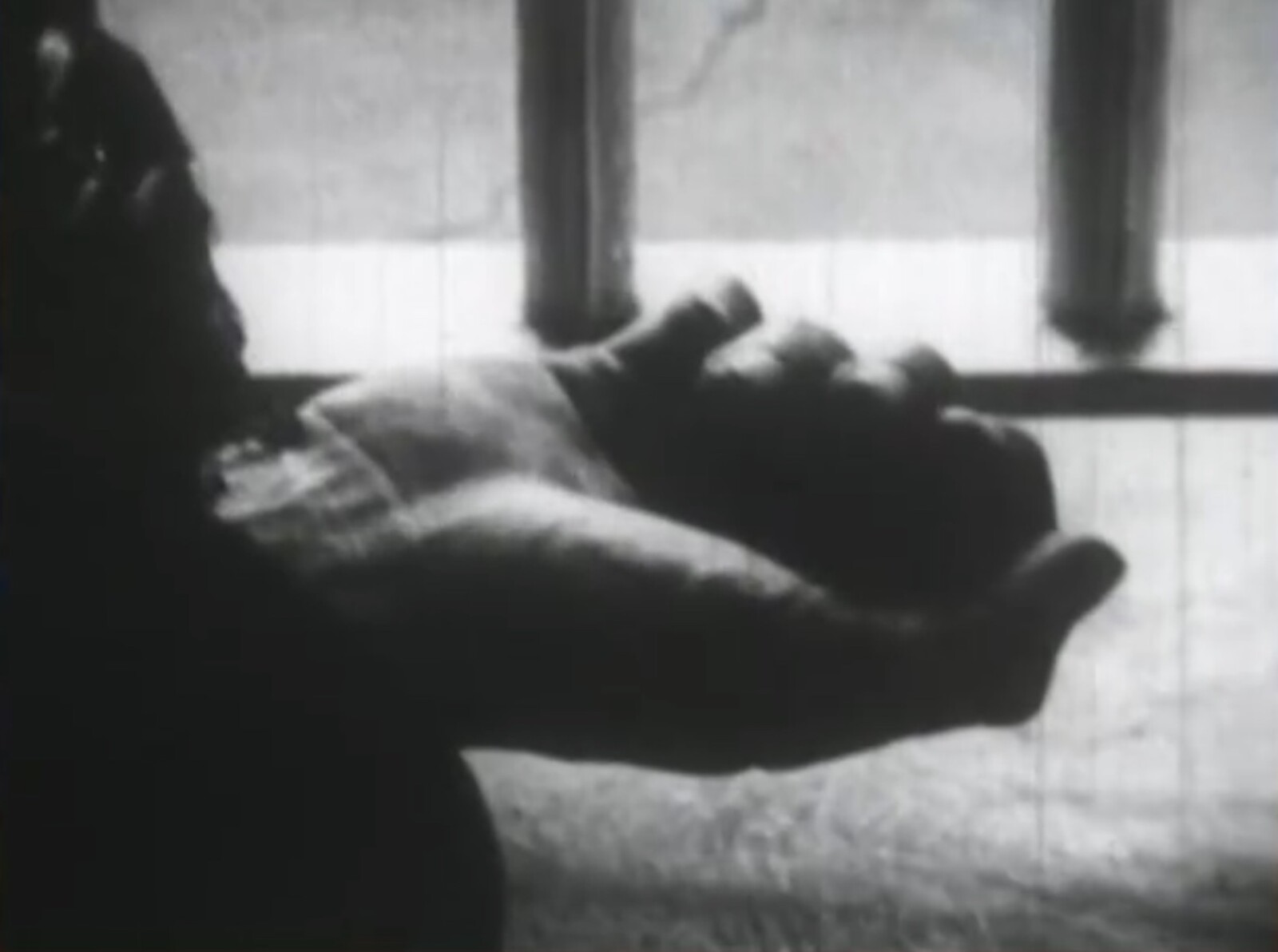
<p>In 2012, Domanović did an interview with the Slovenian computer scientist Borka Jerman Blažič. Back in 1991, Blažič had registered the domain .yu and introduced the first Internet services to the then Yugoslavia. One year later, the country began to violently tear itself apart. Domanović was born in the former Yugoslavia, in the Serbian city of Novi Sad, but grew up in the part of the country which later became Slovenia, and in some way perhaps her having lived through a state falling apart geared her focus towards the rituals of power and ideological constructions of history. When she asked Blažič for other Yugoslavian contributions to the progress of science, she told Domanović about the so-called “Belgrade Hand,” a controllable prosthesis invented in 1963.</p>
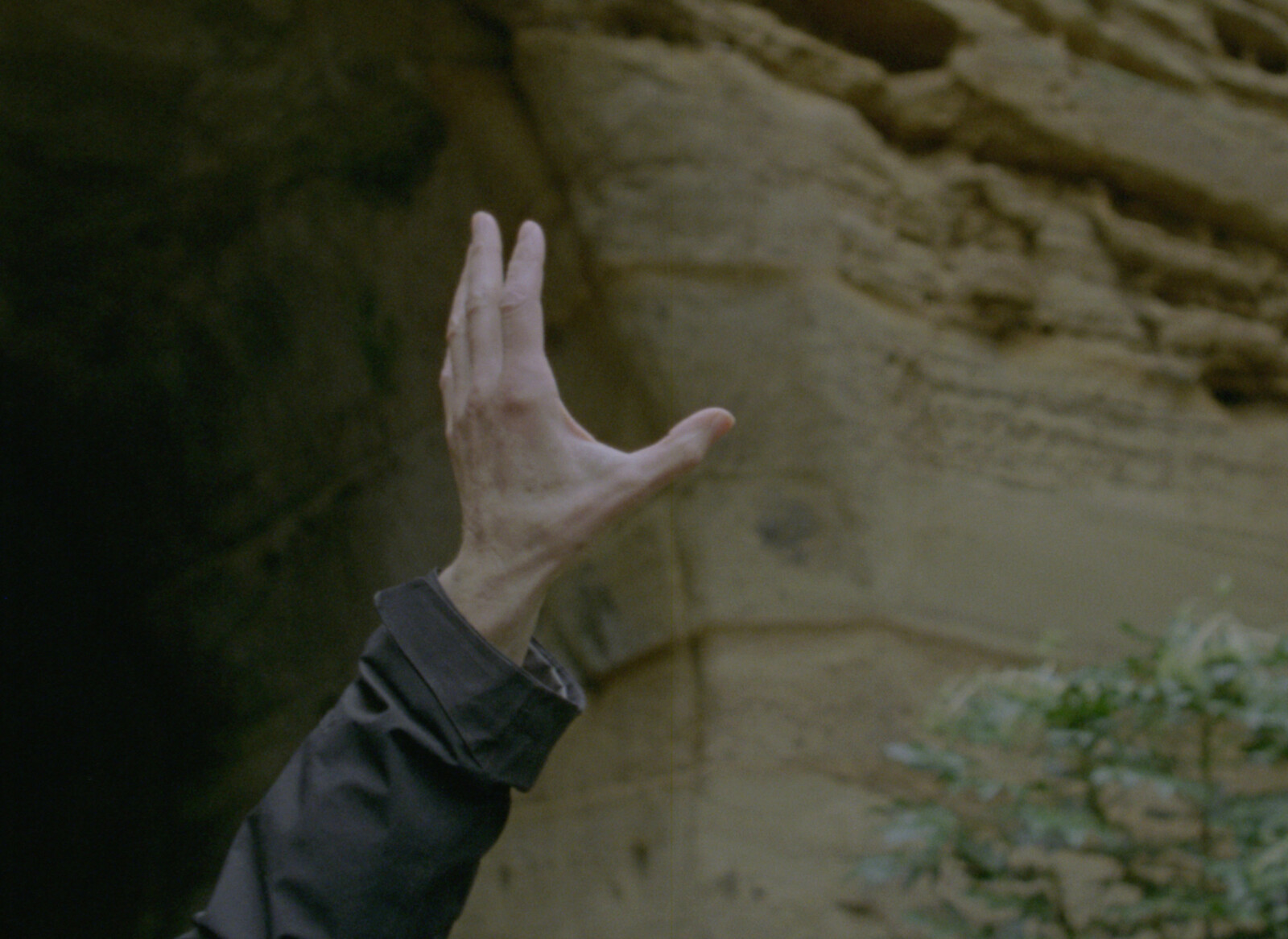
<p>For her show, Domanović had the hand digitally rebuilt as a rigged 3D model, which allowed her to act out a variety of gestures. What we see in the gallery are four hands cast through a laser sintering process. Three of them sit atop obelisk-shaped plinths made of acrylic glass, a fourth is mounted on the wall. Two of the hands and the frame of a large ink-jet print displayed in the backroom are coated with a layer of “Soft-Touch,” a polyurethane-based coating that feels like an organic surface, almost like leather, and is commonly used in interiors, for example, of cars, but also for book covers. The framed print, <em>Belgrade Hand on Minsky Tentacle Arm</em> (2013), shows the hand mounted on an extended robotic arm. This limb without a body is set against a hazy background of sherbert lime, lemon, and orange. The appearance is both sensual and slick—situated between a Konrad Klapheck (German Pop) painting and an illustration in a magazine for nerdy engineers.</p>
<p>The whole assemblage of re-cast or rendered robot hands in shiny metal or coated with seemingly organic surfaces point to a cyborg fantasy that itself has become history. Domanović names Sadie Plant&#8217;s <em>Zeros and Ones</em> (1997) as a reference, but it has been sixteen years since that crucial text of the cyberfeminist movement appeared. Of course, the discourse did not end there (Rosi Braidotti&#8217;s 2013 book <em>The</em> <em>Posthuman</em> is just one recent example). But this is not the artist’s point. The exhibition takes an almost nostalgic or even romanticizing look back at early feminist attempts to imagine a technoid future. In this respect, the figure of the cyborg resembles the state of Yugoslavia: both futures did not take place.</p>
<p>That is, Domanović’s artworks render this Yugoslavian cyborg-complex in the same well-observed and yet detached attitude suggested in her earlier works dealing with the cultural heritage of the former Yugoslavia. Her documentary video <em>Turbo Sculpture</em> (2009–2012), for example, describes the public monuments erected in the 1990s, which put blockbuster heroes like Bruce Lee or Rocky Balboa and even Johnny Depp on a pedestal in the middle of several small town squares.</p>
<p>However, neither the figure of the cyborg, nor the imagination of Yugoslavia as a united multi-national state (nor new heroes, for that matter) live up to the promise of a better future. But it’s also not necessarily a future past. It lingers as an unfinished history, temporarily suspended in limbo.</p>
<p>The Belgrade Hand was known for a very simple automatic control mechanism. As soon as its fingertip came into contact with an object, it would automatically close. The phrase “the future was at her fingertips” is borrowed from Plant, referring to the untold number of switchboard operators from the 1930s onwards. Very literally, these women had the future at their fingertips, but it never played out in their favor. As switchboards were automated in the 1950s, the mostly female workers (who were actually referred to as “computers” at the time), lost their jobs, ironically, to what we now call computers.</p>
<p>But Domanović’s hand sculptures reach out to a much wider (time)frame. Two are linked to classic gestures of Christian iconography. One takes the shape of a Buddhist mudra and the other, made of solid Yugoslav chestnut and mounted on the wall, holds a relay runner&#8217;s baton. What looks like a random choice of gestures has one aspect in common: time, itself, is overcome here, be it through eternity, nirvana, or repetition.</p>
<p>Domanović’s timeline doesn&#8217;t end with the contemporary. It extends into the future. “2025 New Zealand is completely smoke free.” Just like that, for no reason, the artist replied when I asked her why she had included that detail. The last entry quotes Ray Kurzweil&#8217;s prediction: “2099 most conscious beings lack a permanent physical form.” Looking back from the end of the twenty-first century to our present day, one can imagine the same bewildered disbelief at a past future that looked so different from what came. In this respect, the relations between human and technical beings may turn into an amplified version of what happened to the people in Yugoslavia. Only this time it is intellectual (and not territorial) sovereignty that has been called into question. The Belgrade Hand, after all, may be an appropriate element to annex the future of both, as it endeavors to escape into timelessness.</p>
]]></content:encoded>
			<wfw:commentRss>http://www.art-agenda.com/reviews/aleksandra-domanovic%e2%80%99s-%e2%80%9cthe-future-was-at-her-fingertips%e2%80%9d/feed/</wfw:commentRss>
		<slash:comments>0</slash:comments>
		</item>
		<item>
		<title>“I’m Not Involved in Aesthetic Progress: A Rethinking of Performance”</title>
		<link>http://www.art-agenda.com/reviews/%e2%80%9ci%e2%80%99m-not-involved-in-aesthetic-progress-a-rethinking-of-performance%e2%80%9d/</link>
		<comments>http://www.art-agenda.com/reviews/%e2%80%9ci%e2%80%99m-not-involved-in-aesthetic-progress-a-rethinking-of-performance%e2%80%9d/#comments</comments>
		<pubDate>Thu, 02 May 2013 08:35:49 +0000</pubDate>
		<dc:creator>Edward Sanderson</dc:creator>
		<logo><![CDATA[<img width="220" height="146" src="http://www.art-agenda.com/wp-content/uploads/2013/04/1_Installation-View-1_Courtesy-of-Star-Gallery-220x146.jpg" class="attachment-client-logo" alt="View of “I’m Not Involved In Aesthetic Progress: A Rethinking of Performance,” Star Gallery, Beijing, 2013." title="View of “I’m Not Involved In Aesthetic Progress: A Rethinking of Performance,” Star Gallery, Beijing, 2013." />]]></logo>
				<category><![CDATA[Reviews]]></category>

		<guid isPermaLink="false">http://www.art-agenda.com/?p=10013102</guid>
		<description><![CDATA[In this inaugural exhibition in Star Gallery’s new Beijing space, curator Su Wei addresses certain perceived limitations in the discourse surrounding Chinese performance art. Drawing on the work of eight artists, the presentation avoids “formulated mechanisms,” Su writes, to specifically address works “irreducible to any classification within]]></description>
			<content:encoded><![CDATA[<div id="_mcePaste"><!--[if gte mso 9]><xml> <o:DocumentProperties> <o:Revision>0</o:Revision> <o:TotalTime>0</o:TotalTime> <o:Pages>1</o:Pages> <o:Words>81</o:Words> <o:Characters>490</o:Characters> <o:Company>e-flux</o:Company> <o:Lines>9</o:Lines> <o:Paragraphs>2</o:Paragraphs> <o:CharactersWithSpaces>569</o:CharactersWithSpaces> <o:Version>14.0</o:Version> </o:DocumentProperties> <o:OfficeDocumentSettings> <o:AllowPNG /> </o:OfficeDocumentSettings> </xml><![endif]--> <!--[if gte mso 9]><xml> <w:WordDocument> <w:View>Normal</w:View> <w:Zoom>0</w:Zoom> <w:TrackMoves /> <w:TrackFormatting /> <w:PunctuationKerning /> <w:ValidateAgainstSchemas /> <w:SaveIfXMLInvalid>false</w:SaveIfXMLInvalid> <w:IgnoreMixedContent>false</w:IgnoreMixedContent> <w:AlwaysShowPlaceholderText>false</w:AlwaysShowPlaceholderText> <w:DoNotPromoteQF /> <w:LidThemeOther>DE</w:LidThemeOther> <w:LidThemeAsian>JA</w:LidThemeAsian> <w:LidThemeComplexScript>X-NONE</w:LidThemeComplexScript> <w:Compatibility> <w:BreakWrappedTables /> <w:SnapToGridInCell /> <w:WrapTextWithPunct /> <w:UseAsianBreakRules /> <w:DontGrowAutofit /> <w:SplitPgBreakAndParaMark /> <w:EnableOpenTypeKerning /> <w:DontFlipMirrorIndents /> <w:OverrideTableStyleHps /> </w:Compatibility> <m:mathPr> <m:mathFont m:val="Cambria Math" /> <m:brkBin m:val="before" /> <m:brkBinSub m:val="&#45;-" /> <m:smallFrac m:val="off" /> <m:dispDef /> <m:lMargin m:val="0" /> <m:rMargin m:val="0" /> <m:defJc m:val="centerGroup" /> <m:wrapIndent m:val="1440" /> <m:intLim m:val="subSup" /> <m:naryLim m:val="undOvr" /> </m:mathPr></w:WordDocument> </xml><![endif]--><!--[if gte mso 9]><xml> <w:LatentStyles DefLockedState="false" DefUnhideWhenUsed="true"   DefSemiHidden="true" DefQFormat="false" DefPriority="99"   LatentStyleCount="276"> <w:LsdException Locked="false" Priority="0" SemiHidden="false"    UnhideWhenUsed="false" QFormat="true" Name="Normal" /> <w:LsdException Locked="false" Priority="9" SemiHidden="false"    UnhideWhenUsed="false" QFormat="true" Name="heading 1" /> <w:LsdException Locked="false" Priority="9" QFormat="true" Name="heading 2" /> <w:LsdException Locked="false" Priority="9" QFormat="true" Name="heading 3" /> <w:LsdException Locked="false" Priority="9" QFormat="true" Name="heading 4" /> <w:LsdException Locked="false" Priority="9" QFormat="true" Name="heading 5" /> <w:LsdException Locked="false" Priority="9" QFormat="true" Name="heading 6" /> <w:LsdException Locked="false" Priority="9" QFormat="true" Name="heading 7" /> <w:LsdException Locked="false" Priority="9" QFormat="true" Name="heading 8" /> <w:LsdException Locked="false" Priority="9" QFormat="true" Name="heading 9" /> <w:LsdException Locked="false" Priority="39" Name="toc 1" /> <w:LsdException Locked="false" Priority="39" Name="toc 2" /> <w:LsdException Locked="false" Priority="39" Name="toc 3" /> <w:LsdException Locked="false" Priority="39" Name="toc 4" /> <w:LsdException Locked="false" Priority="39" Name="toc 5" /> <w:LsdException Locked="false" Priority="39" Name="toc 6" /> <w:LsdException Locked="false" Priority="39" Name="toc 7" /> <w:LsdException Locked="false" Priority="39" Name="toc 8" /> <w:LsdException Locked="false" Priority="39" Name="toc 9" /> <w:LsdException Locked="false" Priority="35" QFormat="true" Name="caption" /> <w:LsdException Locked="false" Priority="10" SemiHidden="false"    UnhideWhenUsed="false" QFormat="true" Name="Title" /> <w:LsdException Locked="false" Priority="1" Name="Default Paragraph Font" /> <w:LsdException Locked="false" Priority="11" SemiHidden="false"    UnhideWhenUsed="false" QFormat="true" Name="Subtitle" /> <w:LsdException Locked="false" Priority="0" Name="Hyperlink" /> <w:LsdException Locked="false" Priority="22" SemiHidden="false"    UnhideWhenUsed="false" QFormat="true" Name="Strong" /> <w:LsdException Locked="false" Priority="20" SemiHidden="false"    UnhideWhenUsed="false" QFormat="true" Name="Emphasis" /> <w:LsdException Locked="false" Priority="59" SemiHidden="false"    UnhideWhenUsed="false" Name="Table Grid" /> <w:LsdException Locked="false" UnhideWhenUsed="false" Name="Placeholder Text" /> <w:LsdException Locked="false" Priority="1" SemiHidden="false"    UnhideWhenUsed="false" QFormat="true" Name="No Spacing" /> <w:LsdException Locked="false" Priority="60" SemiHidden="false"    UnhideWhenUsed="false" Name="Light Shading" /> <w:LsdException Locked="false" Priority="61" SemiHidden="false"    UnhideWhenUsed="false" Name="Light List" /> <w:LsdException Locked="false" Priority="62" SemiHidden="false"    UnhideWhenUsed="false" Name="Light Grid" /> <w:LsdException Locked="false" Priority="63" SemiHidden="false"    UnhideWhenUsed="false" Name="Medium Shading 1" /> <w:LsdException Locked="false" Priority="64" SemiHidden="false"    UnhideWhenUsed="false" Name="Medium Shading 2" /> <w:LsdException Locked="false" Priority="65" SemiHidden="false"    UnhideWhenUsed="false" Name="Medium List 1" /> <w:LsdException Locked="false" Priority="66" SemiHidden="false"    UnhideWhenUsed="false" Name="Medium List 2" /> <w:LsdException Locked="false" Priority="67" SemiHidden="false"    UnhideWhenUsed="false" Name="Medium Grid 1" /> <w:LsdException Locked="false" Priority="68" SemiHidden="false"    UnhideWhenUsed="false" Name="Medium Grid 2" /> <w:LsdException Locked="false" Priority="69" SemiHidden="false"    UnhideWhenUsed="false" Name="Medium Grid 3" /> <w:LsdException Locked="false" Priority="70" SemiHidden="false"    UnhideWhenUsed="false" Name="Dark List" /> <w:LsdException Locked="false" Priority="71" SemiHidden="false"    UnhideWhenUsed="false" Name="Colorful Shading" /> <w:LsdException Locked="false" Priority="72" SemiHidden="false"    UnhideWhenUsed="false" Name="Colorful List" /> <w:LsdException Locked="false" Priority="73" SemiHidden="false"    UnhideWhenUsed="false" Name="Colorful Grid" /> <w:LsdException Locked="false" Priority="60" SemiHidden="false"    UnhideWhenUsed="false" Name="Light Shading Accent 1" /> <w:LsdException Locked="false" Priority="61" SemiHidden="false"    UnhideWhenUsed="false" Name="Light List Accent 1" /> <w:LsdException Locked="false" Priority="62" SemiHidden="false"    UnhideWhenUsed="false" Name="Light Grid Accent 1" /> <w:LsdException Locked="false" Priority="63" SemiHidden="false"    UnhideWhenUsed="false" Name="Medium Shading 1 Accent 1" /> <w:LsdException Locked="false" Priority="64" SemiHidden="false"    UnhideWhenUsed="false" Name="Medium Shading 2 Accent 1" /> <w:LsdException Locked="false" Priority="65" SemiHidden="false"    UnhideWhenUsed="false" Name="Medium List 1 Accent 1" /> <w:LsdException Locked="false" UnhideWhenUsed="false" Name="Revision" /> <w:LsdException Locked="false" Priority="34" SemiHidden="false"    UnhideWhenUsed="false" QFormat="true" Name="List Paragraph" /> <w:LsdException Locked="false" Priority="29" SemiHidden="false"    UnhideWhenUsed="false" QFormat="true" Name="Quote" /> <w:LsdException Locked="false" Priority="30" SemiHidden="false"    UnhideWhenUsed="false" QFormat="true" Name="Intense Quote" /> <w:LsdException Locked="false" Priority="66" SemiHidden="false"    UnhideWhenUsed="false" Name="Medium List 2 Accent 1" /> <w:LsdException Locked="false" Priority="67" SemiHidden="false"    UnhideWhenUsed="false" Name="Medium Grid 1 Accent 1" /> <w:LsdException Locked="false" Priority="68" SemiHidden="false"    UnhideWhenUsed="false" Name="Medium Grid 2 Accent 1" /> <w:LsdException Locked="false" Priority="69" SemiHidden="false"    UnhideWhenUsed="false" Name="Medium Grid 3 Accent 1" /> <w:LsdException Locked="false" Priority="70" SemiHidden="false"    UnhideWhenUsed="false" Name="Dark List Accent 1" /> <w:LsdException Locked="false" Priority="71" SemiHidden="false"    UnhideWhenUsed="false" Name="Colorful Shading Accent 1" /> <w:LsdException Locked="false" Priority="72" SemiHidden="false"    UnhideWhenUsed="false" Name="Colorful List Accent 1" /> <w:LsdException Locked="false" Priority="73" SemiHidden="false"    UnhideWhenUsed="false" Name="Colorful Grid Accent 1" /> <w:LsdException Locked="false" Priority="60" SemiHidden="false"    UnhideWhenUsed="false" Name="Light Shading Accent 2" /> <w:LsdException Locked="false" Priority="61" SemiHidden="false"    UnhideWhenUsed="false" Name="Light List Accent 2" /> <w:LsdException Locked="false" Priority="62" SemiHidden="false"    UnhideWhenUsed="false" Name="Light Grid Accent 2" /> <w:LsdException Locked="false" Priority="63" SemiHidden="false"    UnhideWhenUsed="false" Name="Medium Shading 1 Accent 2" /> <w:LsdException Locked="false" Priority="64" SemiHidden="false"    UnhideWhenUsed="false" Name="Medium Shading 2 Accent 2" /> <w:LsdException Locked="false" Priority="65" SemiHidden="false"    UnhideWhenUsed="false" Name="Medium List 1 Accent 2" /> <w:LsdException Locked="false" Priority="66" SemiHidden="false"    UnhideWhenUsed="false" Name="Medium List 2 Accent 2" /> <w:LsdException Locked="false" Priority="67" SemiHidden="false"    UnhideWhenUsed="false" Name="Medium Grid 1 Accent 2" /> <w:LsdException Locked="false" Priority="68" SemiHidden="false"    UnhideWhenUsed="false" Name="Medium Grid 2 Accent 2" /> <w:LsdException Locked="false" Priority="69" SemiHidden="false"    UnhideWhenUsed="false" Name="Medium Grid 3 Accent 2" /> <w:LsdException Locked="false" Priority="70" SemiHidden="false"    UnhideWhenUsed="false" Name="Dark List Accent 2" /> <w:LsdException Locked="false" Priority="71" SemiHidden="false"    UnhideWhenUsed="false" Name="Colorful Shading Accent 2" /> <w:LsdException Locked="false" Priority="72" SemiHidden="false"    UnhideWhenUsed="false" Name="Colorful List Accent 2" /> <w:LsdException Locked="false" Priority="73" SemiHidden="false"    UnhideWhenUsed="false" Name="Colorful Grid Accent 2" /> <w:LsdException Locked="false" Priority="60" SemiHidden="false"    UnhideWhenUsed="false" Name="Light Shading Accent 3" /> <w:LsdException Locked="false" Priority="61" SemiHidden="false"    UnhideWhenUsed="false" Name="Light List Accent 3" /> <w:LsdException Locked="false" Priority="62" SemiHidden="false"    UnhideWhenUsed="false" Name="Light Grid Accent 3" /> <w:LsdException Locked="false" Priority="63" SemiHidden="false"    UnhideWhenUsed="false" Name="Medium Shading 1 Accent 3" /> <w:LsdException Locked="false" Priority="64" SemiHidden="false"    UnhideWhenUsed="false" Name="Medium Shading 2 Accent 3" /> <w:LsdException Locked="false" Priority="65" SemiHidden="false"    UnhideWhenUsed="false" Name="Medium List 1 Accent 3" /> <w:LsdException Locked="false" Priority="66" SemiHidden="false"    UnhideWhenUsed="false" Name="Medium List 2 Accent 3" /> <w:LsdException Locked="false" Priority="67" SemiHidden="false"    UnhideWhenUsed="false" Name="Medium Grid 1 Accent 3" /> <w:LsdException Locked="false" Priority="68" SemiHidden="false"    UnhideWhenUsed="false" Name="Medium Grid 2 Accent 3" /> <w:LsdException Locked="false" Priority="69" SemiHidden="false"    UnhideWhenUsed="false" Name="Medium Grid 3 Accent 3" /> <w:LsdException Locked="false" Priority="70" SemiHidden="false"    UnhideWhenUsed="false" Name="Dark List Accent 3" /> <w:LsdException Locked="false" Priority="71" SemiHidden="false"    UnhideWhenUsed="false" Name="Colorful Shading Accent 3" /> <w:LsdException Locked="false" Priority="72" SemiHidden="false"    UnhideWhenUsed="false" Name="Colorful List Accent 3" /> <w:LsdException Locked="false" Priority="73" SemiHidden="false"    UnhideWhenUsed="false" Name="Colorful Grid Accent 3" /> <w:LsdException Locked="false" Priority="60" SemiHidden="false"    UnhideWhenUsed="false" Name="Light Shading Accent 4" /> <w:LsdException Locked="false" Priority="61" SemiHidden="false"    UnhideWhenUsed="false" Name="Light List Accent 4" /> <w:LsdException Locked="false" Priority="62" SemiHidden="false"    UnhideWhenUsed="false" Name="Light Grid Accent 4" /> <w:LsdException Locked="false" Priority="63" SemiHidden="false"    UnhideWhenUsed="false" Name="Medium Shading 1 Accent 4" /> <w:LsdException Locked="false" Priority="64" SemiHidden="false"    UnhideWhenUsed="false" Name="Medium Shading 2 Accent 4" /> <w:LsdException Locked="false" Priority="65" SemiHidden="false"    UnhideWhenUsed="false" Name="Medium List 1 Accent 4" /> <w:LsdException Locked="false" Priority="66" SemiHidden="false"    UnhideWhenUsed="false" Name="Medium List 2 Accent 4" /> <w:LsdException Locked="false" Priority="67" SemiHidden="false"    UnhideWhenUsed="false" Name="Medium Grid 1 Accent 4" /> <w:LsdException Locked="false" Priority="68" SemiHidden="false"    UnhideWhenUsed="false" Name="Medium Grid 2 Accent 4" /> <w:LsdException Locked="false" Priority="69" SemiHidden="false"    UnhideWhenUsed="false" Name="Medium Grid 3 Accent 4" /> <w:LsdException Locked="false" Priority="70" SemiHidden="false"    UnhideWhenUsed="false" Name="Dark List Accent 4" /> <w:LsdException Locked="false" Priority="71" SemiHidden="false"    UnhideWhenUsed="false" Name="Colorful Shading Accent 4" /> <w:LsdException Locked="false" Priority="72" SemiHidden="false"    UnhideWhenUsed="false" Name="Colorful List Accent 4" /> <w:LsdException Locked="false" Priority="73" SemiHidden="false"    UnhideWhenUsed="false" Name="Colorful Grid Accent 4" /> <w:LsdException Locked="false" Priority="60" SemiHidden="false"    UnhideWhenUsed="false" Name="Light Shading Accent 5" /> <w:LsdException Locked="false" Priority="61" SemiHidden="false"    UnhideWhenUsed="false" Name="Light List Accent 5" /> <w:LsdException Locked="false" Priority="62" SemiHidden="false"    UnhideWhenUsed="false" Name="Light Grid Accent 5" /> <w:LsdException Locked="false" Priority="63" SemiHidden="false"    UnhideWhenUsed="false" Name="Medium Shading 1 Accent 5" /> <w:LsdException Locked="false" Priority="64" SemiHidden="false"    UnhideWhenUsed="false" Name="Medium Shading 2 Accent 5" /> <w:LsdException Locked="false" Priority="65" SemiHidden="false"    UnhideWhenUsed="false" Name="Medium List 1 Accent 5" /> <w:LsdException Locked="false" Priority="66" SemiHidden="false"    UnhideWhenUsed="false" Name="Medium List 2 Accent 5" /> <w:LsdException Locked="false" Priority="67" SemiHidden="false"    UnhideWhenUsed="false" Name="Medium Grid 1 Accent 5" /> <w:LsdException Locked="false" Priority="68" SemiHidden="false"    UnhideWhenUsed="false" Name="Medium Grid 2 Accent 5" /> <w:LsdException Locked="false" Priority="69" SemiHidden="false"    UnhideWhenUsed="false" Name="Medium Grid 3 Accent 5" /> <w:LsdException Locked="false" Priority="70" SemiHidden="false"    UnhideWhenUsed="false" Name="Dark List Accent 5" /> <w:LsdException Locked="false" Priority="71" SemiHidden="false"    UnhideWhenUsed="false" Name="Colorful Shading Accent 5" /> <w:LsdException Locked="false" Priority="72" SemiHidden="false"    UnhideWhenUsed="false" Name="Colorful List Accent 5" /> <w:LsdException Locked="false" Priority="73" SemiHidden="false"    UnhideWhenUsed="false" Name="Colorful Grid Accent 5" /> <w:LsdException Locked="false" Priority="60" SemiHidden="false"    UnhideWhenUsed="false" Name="Light Shading Accent 6" /> <w:LsdException Locked="false" Priority="61" SemiHidden="false"    UnhideWhenUsed="false" Name="Light List Accent 6" /> <w:LsdException Locked="false" Priority="62" SemiHidden="false"    UnhideWhenUsed="false" Name="Light Grid Accent 6" /> <w:LsdException Locked="false" Priority="63" SemiHidden="false"    UnhideWhenUsed="false" Name="Medium Shading 1 Accent 6" /> <w:LsdException Locked="false" Priority="64" SemiHidden="false"    UnhideWhenUsed="false" Name="Medium Shading 2 Accent 6" /> <w:LsdException Locked="false" Priority="65" SemiHidden="false"    UnhideWhenUsed="false" Name="Medium List 1 Accent 6" /> <w:LsdException Locked="false" Priority="66" SemiHidden="false"    UnhideWhenUsed="false" Name="Medium List 2 Accent 6" /> <w:LsdException Locked="false" Priority="67" SemiHidden="false"    UnhideWhenUsed="false" Name="Medium Grid 1 Accent 6" /> <w:LsdException Locked="false" Priority="68" SemiHidden="false"    UnhideWhenUsed="false" Name="Medium Grid 2 Accent 6" /> <w:LsdException Locked="false" Priority="69" SemiHidden="false"    UnhideWhenUsed="false" Name="Medium Grid 3 Accent 6" /> <w:LsdException Locked="false" Priority="70" SemiHidden="false"    UnhideWhenUsed="false" Name="Dark List Accent 6" /> <w:LsdException Locked="false" Priority="71" SemiHidden="false"    UnhideWhenUsed="false" Name="Colorful Shading Accent 6" /> <w:LsdException Locked="false" Priority="72" SemiHidden="false"    UnhideWhenUsed="false" Name="Colorful List Accent 6" /> <w:LsdException Locked="false" Priority="73" SemiHidden="false"    UnhideWhenUsed="false" Name="Colorful Grid Accent 6" /> <w:LsdException Locked="false" Priority="19" SemiHidden="false"    UnhideWhenUsed="false" QFormat="true" Name="Subtle Emphasis" /> <w:LsdException Locked="false" Priority="21" SemiHidden="false"    UnhideWhenUsed="false" QFormat="true" Name="Intense Emphasis" /> <w:LsdException Locked="false" Priority="31" SemiHidden="false"    UnhideWhenUsed="false" QFormat="true" Name="Subtle Reference" /> <w:LsdException Locked="false" Priority="32" SemiHidden="false"    UnhideWhenUsed="false" QFormat="true" Name="Intense Reference" /> <w:LsdException Locked="false" Priority="33" SemiHidden="false"    UnhideWhenUsed="false" QFormat="true" Name="Book Title" /> <w:LsdException Locked="false" Priority="37" Name="Bibliography" /> <w:LsdException Locked="false" Priority="39" QFormat="true" Name="TOC Heading" /> </w:LatentStyles> </xml><![endif]--> <!--[if gte mso 10]><br />
<mce:style><!   /* Style Definitions */ table.MsoNormalTable 	{mso-style-name:"Table Normal"; 	mso-tstyle-rowband-size:0; 	mso-tstyle-colband-size:0; 	mso-style-noshow:yes; 	mso-style-priority:99; 	mso-style-parent:""; 	mso-padding-alt:0in 5.4pt 0in 5.4pt; 	mso-para-margin-top:0in; 	mso-para-margin-right:0in; 	mso-para-margin-bottom:10.0pt; 	mso-para-margin-left:0in; 	mso-pagination:widow-orphan; 	font-size:11.0pt; 	font-family:Garamond; 	mso-ansi-language:DE;} --><!--[endif] --> <!--StartFragment--></p>
<p class="MsoNormal">In this inaugural exhibition in Star Gallery’s new Beijing space, curator Su Wei addresses certain perceived limitations in the discourse surrounding Chinese performance art. Drawing on the work of eight artists, the presentation avoids “formulated mechanisms,” Su writes, to specifically address works “irreducible to any classification within the historical process of aesthetics.” Su proposes that this can be partly accomplished by more fully addressing the original contexts of the performances: “It is impossible to [remove] the work of the artist from its site.”</p>
<p><!--EndFragment--></p>
</div>
<p>Artists Ma Liuming, Zhu Ming, and Xing Danwen were part of the “East Village” community in Beijing in the early 1990s, known for body-art practices (i.e., Ma Liuming cooking naked in his studio’s courtyard) that would eventually lead to the scene being prematurely “shut down” by the police. In this show Ma is represented by documentation of his performance during a visit by British artists Gilbert &amp; George to his studio in 1993 in which he stripped off his shirt and cut into a bag of red ink hidden in the ceiling, which poured down over his body like blood. Video documentation of a performance at the Istanbul Biennale from 2001 is also on view here, for which he reprised his role of “Fen-Ma Liuming” (the Chinese “Fen,” meaning perfume or fragrance, lends a gender-bending twist to the artist’s name), a personage that plays on Ma’s androgynous looks. Where Ma grapples with gender issues, Zhu Ming deals with actions of the body in limited spaces, often performing in an inflated bubble that clearly defines his room to move—and available air. In this show, a sculptural version of one of these plastic bubbles contains a dimly visible cross-legged human figure as a one-to-one souvenir, so to speak, of his performances.</p>
<p>Xing Danwen is well known for her series of photographs documenting the East Village artists. This exhibition displays a set of small prints capturing glimpses of their lives and performances, mounted on a roughly built brick column, perhaps reflecting the squalid conditions in which they lived. The ongoing debate in China over the status of these photographs as either documentation of artists’ work or as an original artwork by the photographer is resolved in this exhibition by not crediting the photographer’s subjects in any way.</p>
<p>Highlighting aspects of futility in the practice of art, Chen Shaoxiong revives two works from his early career, <em>72.5 hours of Electricity Consumption </em>(1992) and <em>Seven-day Silence </em>(1991), the latter documenting the artist’s hushed week painting a series of plastic sheets in mournful black, while the former is a playful set of anthropomorphic metal structures with fluorescent lights linked to electricity meters recording their energy consumption over the allotted time. Chen Shaoxiong’s sometime-collaborator Liu Ding is also featured here with a performance video that focuses on confusing professional roles in the art world in a performative fashion. Here the artist performs as the <em>character</em> “Mr. Liu” (not himself) in a three-way dialogue with two curators, Marko Daniel (of the Tate Modern) and Carol Yinghua Lu (coincidentally also the artist’s wife). Absenting the figure of the artist—the ostensible subject of said discussion—Liu Ding finds himself in the surprising position of being able to provide third-party responses to questions regarding his own artistic practice (<em>I Simply Appear in the Company of…</em>, 2012).</p>
<p>The younger artists in this show, those born in the 1980s—Chen Zhou, Li Qi, and Li Ran—also use performance to set up problematic relations between the real and the fictional. Li Ran, in particular, has made a habit of constructing fictional cultural identities that he acts out in gallery performances or pseudo-documentary videos whose aesthetic would not be out of place on the History Channel. However, for the opening we saw him speaking as himself on the subject of how we look at ourselves within the art industry (<em>Stop Imagining</em>, 2013). The performance aspect of Chen Zhou’s piece, however, is left ambiguous: is the artist creating a fictional subject through this video? Or is this a real document of the subject? Chen’s subject is his friend and fellow artist Yu Honglei. Yu is presented in a tender video as a somewhat melancholy young man leafing through photos of himself as a punkish youth (<em>My Loving Artist Yu Honglei</em>, 2012), but the aims and meanings of this work in the context of this exhibition are difficult to pin down. In a more straightforward fashion, artist Li Qi pitches expertise against amateurism in <em>Manual of Controlled Action—Wrestling Course </em>(2012) in which the artist continually intervenes in a professional wrestler’s demonstration of moves with off-screen commands and suggestions, which subvert and discomfort the expert rather than assisting in any way; and in <em>Biography of Li Xiushi </em>(2013) the artist revisits his childhood attempts at putting on art shows, with a cast of friends providing fictional background and commentary.</p>
<p>While Su presents us with a strong set of works, the way in which they are “problematic” to aesthetic systems ultimately lacks sufficient explanation. Su’s curatorial vision for this exhibition can be seen to extend the critical approach that he and his colleagues Carol Yinghua Lu and Liu Ding (also an artist in the show) have initiated over the past few years. In particular, they have been tackling the thorny question of the place of the individual artist versus the collective (particularly complex within the specific Chinese context), and engaging in a reassessment of works previously dismissed as minor within particular artists’ oeuvres. Despite its flaws, “I’m Not Involved in Aesthetic Progress” productively adds to this process, highlighting works from a set of artists over several generations that deserve this rare opportunity for more sustained critical attention.</p>
]]></content:encoded>
			<wfw:commentRss>http://www.art-agenda.com/reviews/%e2%80%9ci%e2%80%99m-not-involved-in-aesthetic-progress-a-rethinking-of-performance%e2%80%9d/feed/</wfw:commentRss>
		<slash:comments>0</slash:comments>
		</item>
		<item>
		<title>Gallery Weekend Berlin</title>
		<link>http://www.art-agenda.com/reviews/gallery-weekend-berlin/</link>
		<comments>http://www.art-agenda.com/reviews/gallery-weekend-berlin/#comments</comments>
		<pubDate>Mon, 29 Apr 2013 19:40:49 +0000</pubDate>
		<dc:creator>Kimberly Bradley</dc:creator>
		<logo><![CDATA[<img width="220" height="146" src="http://www.art-agenda.com/wp-content/uploads/2013/04/1_KOW-1-220x146.jpg" class="attachment-client-logo" alt="View of Michael E. Smith, KOW, Berlin, 2013." title="View of Michael E. Smith, KOW, Berlin, 2013." />]]></logo>
				<category><![CDATA[Reviews]]></category>

		<guid isPermaLink="false">http://www.art-agenda.com/?p=10013057</guid>
		<description><![CDATA[Berlin’s been looking downright spiffy lately. Design hotels (to host the import-export set), shiny office buildings (populated by “for rent” signs), and self-important artisanal coffee shops keep popping up. There’s a new Waldorf-Astoria. People dress better. These days, when you call a restaurant, store, or gallery, someone actually answers.
It wasn’t]]></description>
			<content:encoded><![CDATA[<p>Berlin’s been looking downright spiffy lately. Design hotels (to host the import-export set), shiny office buildings (populated by “for rent” signs), and self-important artisanal coffee shops keep popping up. There’s a new Waldorf-Astoria. People dress better. These days, when you call a restaurant, store, or gallery, someone actually answers.</p>
<p>It wasn’t always this way. Berlin in general is “professionalizing” (though I hate that word) and gentrifying (so what else is new?), and its art world is no exception. For the first time in its nine-year history, Gallery Weekend Berlin—an event founded by a small group of gallerists to lure international collectors to the city for a springtime weekend—has appointed a general manager (the affable Cédric Aurelle). This year, nearly sixty drivers in black BMWs spirited VIPs from gallery to gallery. The fifty-one exhibitors ranged from emerging to established. It’s hard to quantify how many art lovers the event now draws, but “we think there were about 10,000 people here altogether,” Aurelle told me as he emerged on Saturday afternoon from the gallery VeneKlasen Werner, looking as if he’d just come from a calming spa treatment. Professional indeed.</p>
<p>As a local, it was the first time I’d done the whole (okay, almost whole) gallery weekend <em>on</em> Gallery Weekend, hitting forty-four galleries, mostly solo shows, in the first two days, replicating the experience of a real, dutiful VIP flying in and out. Seeing it all (or did I really see it?) is a recipe for art overload, but joining the fray offered an opportunity to identify threads that are much harder to see when you take your time.</p>
<p>This year’s edition was refreshingly gender balanced. I counted twenty-four women: some of them icons (Maria Lassnig, Isa Genzken), others rising stars (Aleksandra Domanović, Eva Kotátková, Anna K.E.). Strangely, there was also a solid contingent of old-school Austrians—Lassnig (at Capitain Petzel) is ninety-three; Galerie Cinzia Friedlander showed seventy-two-year-old painter Martha Jungwirth; Valie Export, also a septuagenarian, was on view at Żak | Branicka; and Aurel Scheibler showed the late Curt Stenvert, who died in 1992. Hans-Peter Feldmann’s work was to be found in not one but three different venues (I was told that the tripling of shows was a coincidence). At Mehdi Chouakri, the artist atypically showed only rectangles of light projected onto walls painted blue and green. More familiar Feldmann work was on view at Johnen Galerie (paintings in which traditional motifs are humorously manipulated) and Wien Lukatsch (a trove of printed matter, artist’s books, and photographs).</p>
<p>Also startling was the number of contemporary galleries showing work made decades ago: Sassa Trültzsch presented Roswitha Hecke’s vintage black-and-white photographs of a Zurich sex worker named Irene dating to the late 1970s. Supportico Lopez’s fantastic show of the late Henri Chopin displays the poet’s manuscript <em>La Crevette Amoureuse</em> from 1967/1975; Export’s excellent filmic, photographic, and installation pieces from the 1970s and 1980s constituted a well-curated quasi-retrospective of the feminist artist’s career. Dutch Conceptual artist Jan Dibbets reworked color-swatch car-hood images dating to 1976 at Konrad Fischer Galerie, while Galerie Nordenhake showed a photographic essay that Esko Männikkö and Pekka Turunen produced between 1989 and 1995. Even the gallery lineup has shifted—among notable absences this year were Arratia Beer and Chert, while newcomers included Nature Morte and Kraupa-Tuskany Zeidler, whose nearly invisible location on the fourth floor of an office building off Alexanderplatz was perhaps the oddest venue of all (showing the event’s youngest artist, Avery Singer, an American born in 1987).</p>
<p>The beaten path was well-trod, with herds of viewers passing through Contemporary Fine Arts, Sprüth Magers, Eigen + Art’s sleek white-box renovation (highlighting a sweeping and possibly hard-drive erasing magnetic-pendulum installation by Carsten Nicolai), Esther Schipper’s two-story canal-side space, and Guido Baudach’s new location in the front building of the Tagesspiegel complex on Potsdamer Strasse. On Friday night, a cool crowd gathered at Johann König’s vast St. Agnes space, where Alicja Kwade’s light/sound pendulum <em>Nach Osten</em> (2013), makes the most of the decommissioned Brutalist church’s soaring nave with a reference (sigh) to Foucault’s pendulum.  Flashy, but at the same time it felt like something we’ve seen before (a friend quipped, “Ah, swinging light-bulb art!”).</p>
<p>But I found myself lingering longer, and being pleasantly surprised, in quieter outposts. At Circus—a gallery located deep within a landscape of auto repair shops—is a subtle, moving exhibition by German-born Turkish artist Özlem Atlin, whose blurred or doubled photographs, intricately layered collage portraits, or slumping, leaning floor sculptures evoke the tensions between dynamism and fatigue, revealing and concealing. At Wentrup, Nevin Aladağ’s <em>Session</em> (2013) is a hypnotic three-channel video made for this year’s Sharjah Biennial, in which she drags, rolls, or otherwise places musical instruments—a tambourine, drum, rattles, and bells—in urban and rural environments in and around the city. Each instrument represents a Sharjah ethnicity (Pakistani, Indian, Iraqi), making the piece a seemingly unironic portrait of melding cultures, as is the colorful paravent adjacent to it, whose fabric panels are a patchwork of carpet fragments from around the world.</p>
<p>Another surprise was at Aurel Scheibler, the aforementioned Stenvert, who is only recently being rediscovered. The late artist’s production can be neatly divided into chapters: in the 1950s he made films, in the 1960s he turned to three-dimensional collage assemblage, and later still to painting. The hypnotic avant-garde film <em>Der Rabe</em> (1951) is projected onto one wall; dominating the main exhibition space are his Surrealist, neo-Dada assemblages, presented in raised glass vitrines each labeled with a text and an opus number. These combine objects—a guitar with wooden breasts, a tiny kewpie doll—into striking allegories alluding to desire, loneliness, or other universal issues that feel utterly contemporary.</p>
<p>One of the weekend’s most powerful exhibitions was at KOW, which presented the native Detroiter Michael E. Smith’s pared-down object collages. So sparsely installed that they can be difficult to physically locate, the sculptures combine disparate, downmarket everyday objects—a white T-shirt is stretched around a bowl once used to mix bread dough, a flowered pillowcase is tightly wrapped around a canvas, a head-shaped wasp nest is attached to the underside of a plastic chair. The echoes of body parts, the familiar, utilitarian materials exist together but in distant dialogue and eerily evoke the human condition and perhaps even survival in a chaotic world.</p>
<p>One reason Smith’s approach packs so much punch is that it completely lacks the cynicism that seems to be the currency that many younger-generation artists are trading in these days. The clever premise of a show by say, Mandla Reuter at Croy Nielsen, a few blocks away (which is about a letter sent to Los Angeles that was returned with the note “Need Better Address”), feels flippant by contrast.</p>
<p>Which brings up another problem—one of art-world referentiality. In PSM’s new location (a lovely, airy space on Köpenicker Strasse), Ariel Reichman’s exhibition “Dear Felix, I am sorry but we are just too scared to fly,” has the artist painstakingly redrawing, in pencil, Félix González-Torres’s well-known black-and-white photographs of vultures. Funnily, González-Torres is referred to again, with stacks of paper-as-sculpture (albeit piled too high for viewers to take sheets away, González-Torres-style) in Romanian artist Ciprian Muresan’s show at Plan B. Here the press release even reads: “We have all been somewhat reluctantly learning that art does not go anywhere; instead it dances attractively in a circular whirlpool of time. Widespread referentiality in contemporary art finds justification in that.” Muresan is aware of what he’s doing, but we can only wonder: who, beyond smug art-world insiders, really wants to spin around in a temporal whirlpool and end up in a land of repetition?</p>
<p>On Saturday night, hundreds of people gathered for the Gallery Weekend Gala Dinner at Kraftwerk Berlin—a raw Spree-side power plant whose interior makes you wonder what Tate Modern’s Turbine Hall looked like before it was renovated. After dinner, a deep throbbing sound began to emerge from the building’s bowels, which eventually gathered momentum and turned into a monumental light and sound show by Carsten Nicolai. It felt like good old 1990s club-culture Berlin with an added dose of “professionalism” minus the nose rings or torn fishnets. Those of us who actually frequented such places in the old Berlin felt fabulously transported back in time. The imported well-heeled visitors were dazzled by the Berlin-ness of it all—and, after all, Gallery Weekend is, in essence, a showcase meant for them.</p>
<p>Or is it? These fifty-one shows—in sixty-six venues—remain on view for a full exhibition cycle (most through early June) even after the horde of Gallery Weekenders has gone home. Now that the initial commercial push is over, collectors’ dinners eaten, and solid sales made, there’s time and space to contemplate what’s in the galleries as more than commodities or points on a map to check off one’s list. Seeing so many shows in one go is exhausting, but it’s an important exercise in deciphering where Berlin’s art production and consumption is going. Gallery Weekend is an increasingly successful and well-oiled machine, but we can’t forget that it’s also a once-a-year snapshot of Berlin galleries’ and artists’ best efforts, on their home turf, and its multidimensionality makes us hope we end up somewhere after all.</p>
<p><span style="font-size: 13px; line-height: 19px;"> </span></p>
]]></content:encoded>
			<wfw:commentRss>http://www.art-agenda.com/reviews/gallery-weekend-berlin/feed/</wfw:commentRss>
		<slash:comments>0</slash:comments>
		</item>
		<item>
		<title>Katarina Löfström</title>
		<link>http://www.art-agenda.com/reviews/katarina-lofstrom/</link>
		<comments>http://www.art-agenda.com/reviews/katarina-lofstrom/#comments</comments>
		<pubDate>Fri, 26 Apr 2013 19:08:15 +0000</pubDate>
		<dc:creator>Jacquelyn Davis</dc:creator>
		<logo><![CDATA[<img width="220" height="146" src="http://www.art-agenda.com/wp-content/uploads/2013/04/1_Thought-Form-Embracing-Space-1-220x146.jpg" class="attachment-client-logo" alt="View of Katarina Löfström, Andréhn-Schiptjenko, Stockholm, 2013." title="View of Katarina Löfström, Andréhn-Schiptjenko, Stockholm, 2013." />]]></logo>
				<category><![CDATA[Reviews]]></category>

		<guid isPermaLink="false">http://www.art-agenda.com/?p=10013025</guid>
		<description><![CDATA[In Katarina Löfström’s third solo exhibition at Andréhn-Schiptjenko, one is cajoled by both the comfort of repetition and sensory parameters related to any given reality. Perception, after all, is adaptable and even, at times, restrained. Human beings are able to train themselves to hone attractive skills and master talents through]]></description>
			<content:encoded><![CDATA[<p>In Katarina Löfström’s third solo exhibition at Andréhn-Schiptjenko, one is cajoled by both the comfort of repetition and sensory parameters related to any given reality. Perception, after all, is adaptable and even, at times, restrained. Human beings are able to train themselves to hone attractive skills and master talents through trial and error. Yet we are limited by the physical vessels we inherit, and hindered as our bodies deteriorate over time. As if in response to these constraints, Löfström focuses inward, embracing less circumscribed states—to begin the dialogue between “me” and “myself,” which Plato saw as the essence of thought.</p>
<p>When moving through the space, I found my breathing slowing down—I felt <em>myself</em> slowing down—as if the artist was inviting me to feel no shame in taking refuge in what is provided. Low, ambient sounds drone from the video <em>A Void</em> (2013), reminiscent of Robert Fripp &amp; Brian Eno collaborations or soundtracks from sci-fi films such as Stanley Kubrick’s <em>2001: A Space Odyssey</em> (1968), minus the paranoia. When viewing Löfström’s consciousness-expanding collage works (on view alongside the video), no text is displayed in association or clarification and no parameters are defined, persuading one to develop a language based solely upon images. With this lack of linguistic signs or signifiers, the viewer must move <em>through</em> the image to access communication—and there is no way around this trajectory for Löfström. She highlights that which cannot be said or expressed via conventional language or the practicality of speech: the incomprehensible, uncharted, evolving.</p>
<p>It is useful to question whether or not one can construct an alternative language without referring to other languages. Gertrude Stein’s “A rose is a rose is a rose is a rose” reminds us that a rose is always a rose, but with art, a rose is no longer a rose: it has been manipulated to become something else. The rose becomes what the artist (and viewer) wants it to become. But in the absence of textual references, Löfström provokes dissociative freedom. The viewer is not encouraged to pair up predictable text-image sequences or default relationships. Nevertheless there remains the question of how the collage series on view relates to the video installation itself: do these framed works merely function as marketable commodities—to be taken home, possessed—and do they carry the same weight without the accompanying video? Are they to remain together as a group or can they be viewed (and sold) individually? At least at first glance, the collaged images suggest stills from the video; they reveal the same “vitality globules” on the blurred horizon, but reiteration does not guarantee heightened significance.</p>
<p>If we turn to the press text, we learn that what we are witnessing is evidence of the Swedish artist’s investigations into entoptic phenomenon, that is, visual images specific to one individual and not necessarily guaranteed as replicable for others. But the illusions here are not always accessible by more than one person, for these entoptic images are created by a unique retina. Each entopic experience remains intimate—an image interpreted by one brain alone (and sometimes even considered a hallucination). The background images in Löfström’s video <em>A Void</em> were appropriated from both Walt Disney’s <em>Saludos Amigos</em> (1942) and the 1951 film version of Lewis Carroll’s <em>Alice in Wonderland </em>(1865). Coupled with 1960s psychedelic aesthetics—groovy forms hinting at altered consciousness and tapping into parallel worlds—both the video and collage works share glowing, rhombus shapes and leafy arrangements, reminiscent of hypnosis tactics. In the video, instructions such as “Visualize a red triangle inside a blue square suspended in darkness,” are typical meditative imperatives associated with cognitive games that emphasize the significance of the blank slate.</p>
<p>Much can be gained from embracing the void—the ability to locate clarity, reassess priorities, find or question meaning, create new languages. Further, one cannot always be in motion; we require pauses before moving forward to confront new tasks. Jean-Paul Sartre argued: “Everything which may be said of me in my relations with the Other applies to him as well. While I attempt to free myself from the hold of the Other, the Other is trying to free himself from mine; while I seek to enslave the Other, the Other seeks to enslave me.” (1)  Between these power shifts and surfacing conflicts exists a vacuum; such time-outs are well-deserved.</p>
<p><em> </em></p>
<p><em>Thought Form (Embracing Space) </em>(2013) appears to be misplaced—perhaps, an afterthought in the exhibition, yet it is the first piece one encounters. This copper sculpture stands as one of the artist’s many site-specific interventions (though just one from the series is on view here) representing how thoughts and moods move in currents. Since it is the first piece we encounter when entering the gallery, it serves as counterpoint to the monism of the otherwise hallucinatory phenomenon on view. If by exposing the pipes that would have been hidden behind the wall, the myth of the interior versus exterior collapses, all becomes equal. This particular equity (or lack thereof) is challenging to unpack, especially in the context of entoptic phenomena—can the rose remain the rose? Can A remain A? Is A ever congruent to B? What is gained or lost when my A refuses to be your B?</p>
<p>(1) Jean-Paul Sartre, <em>Being and Nothingness</em> (New York: Washington Square Press, 1984), 474–475.</p>
]]></content:encoded>
			<wfw:commentRss>http://www.art-agenda.com/reviews/katarina-lofstrom/feed/</wfw:commentRss>
		<slash:comments>0</slash:comments>
		</item>
	</channel>
</rss>